At-A-Glance Material Matrix

How Do the 4 Commercial Leather Grades Compare in Strength & Longevity?

Before issuing a Bill of Materials (BOM) to a factory, sourcing teams must specify the exact anatomical layer of the hide. Below is the ISO tensile strength and longevity comparison across the four commercial tiers.

Request Physical Swatch Card
Leather Grade TierAnatomical Hide LayerISO 3376 Tensile StrengthPatina & Surface BehaviorService LifespanRecommended Brand Application
Full-Grain Leather100% Unbuffed Top Epidermis & Corium> 22 N/mm² (Highest)High breathability; develops rich organic patina15–25+ YearsLuxury handbags, executive briefcases, bridle belts, heritage jackets
Top-Grain Leather (Corrected / Embossed)Upper hide with 0.1–0.3mm surface lightly buffed & sealed18–22 N/mm² (High)Moderate breathability; stain & water resistant10–15 YearsStructured Saffiano totes, pebbled commuter bags, travel accessories
Genuine / Split Suede LeatherLower corium layer remaining after top grain is split off10–14 N/mm² (Moderate)Napped velvet texture; requires anti-crocking seal5–8 YearsLuxury bag interior linings, suede accent panels, dust pouches
Bonded Leather (Salpa / Reconstituted)Shredded leather fibers bonded with polyurethane latex (10–20% leather)< 6 N/mm² (Low — Structural Filler Only)Non-breathable; never used by Unicon for exterior panels2–4 Years (as exterior)Used strictly as internal structural reinforcement (Italian Salpa)
Chapter 01 // Hide Anatomy & GradingUnicon Leather Engineering Standard

How to Distinguish Full-Grain from Top-Grain Leather?

Direct Answer (Executive Summary)

Full-grain leather retains 100% of the hide's outermost epidermis (corium junction) without any mechanical sanding or buffing, preserving dense interlocking collagen fibers and natural pore micro-structures. Top-grain leather has its uppermost 0.1mm–0.3mm surface lightly buffed to remove healed scars and is sealed with a pigmented or embossed topcoat for uniform visual consistency. Brands can distinguish full-grain by its visible hair follicles, rapid moisture absorption on aniline finishes, and organic patina development, whereas top-grain displays an even, water-repellent surface with slightly lower breathability.

Statistical Proof & Laboratory Benchmarks:

> 22 N/mm²Full-Grain Tensile Strength

Tested per ISO 3376; retains 30–35% higher fiber tear resistance than split hides.

15–25+ YearsConsumer Lifespan

Full-grain develops a protective burnished patina without surface delamination.

Top 12–15%Raw Hide Selection Yield

Only blemish-free Grade-A hides qualify for unbuffed full-grain aniline production.

Key Procurement & Technical Specifications:

  • Surface Pore Inspection (10x Loupe Test)

    Full-grain hides reveal irregular, organic hair pore clusters under 10x magnification; corrected top-grain hides exhibit a uniform mechanical grain plate or cross-hatch Saffiano pattern.

  • Cross-Section Fiber Density

    In a clean cut edge, full-grain leather displays a tight, non-fraying grain junction at the top 0.4mm, whereas split or genuine leather shows loose, fibrous suede strands throughout.

  • Water Drop & Patina Reaction

    Semi-aniline and vegetable-tanned full-grain hides absorb a tiny water droplet within 5–10 seconds (darkening temporarily), while pigmented top-grain beads water on the surface.

  • Strategic Brand Application

    Specify full-grain leather for heritage satchels, bridle belts, executive briefcases, and luxury jackets; specify top-grain (Saffiano or pebbled) for high-wear structured commuter totes and travel accessories requiring scratch and stain resistance.

Ready to apply these specifications to your brand's next leather collection?

Chapter 02 // ESG & Tannery AuditsUnicon Leather Engineering Standard

What Are Sustainable Tanning Standards?

Direct Answer (Executive Summary)

Sustainable tanning standards are third-party audited environmental, chemical, and traceability protocols—led globally by the Leather Working Group (LWG), ISO 14001, and ZDHC (Zero Discharge of Hazardous Chemicals)—that govern water consumption, effluent treatment, energy use, and raw hide origin. To qualify as sustainably tanned, a tannery must operate closed-loop chromium recycling or chrome-free vegetable/synthetic tanning, maintain 100% slaughterhouse traceability with zero deforestation links, and pass independent laboratory screening for restricted substances. Unicon Leather sources 100% of its export hides from LWG Gold and Silver-rated partner tanneries.

Statistical Proof & Laboratory Benchmarks:

85+ / 100LWG Gold Audit Threshold

Requires minimum 85% score across traceability, water, energy, and waste management.

38–50% LessFreshwater Consumption

Achieved via LWG-audited closed-loop drum recycling vs. conventional tanneries.

< 3.0 ppmChromium VI Safety Limit

Strict ISO 17075-1 threshold mandated by EU REACH Annex XVII Entry 47.

Key Procurement & Technical Specifications:

  • Leather Working Group (LWG) Gold & Silver Ratings

    Audits tanneries across 170+ environmental data points including effluent treatment plant (ETP) biological oxygen demand (BOD), solid waste repurposing, and restricted substance lists (RSL).

  • 100% Food-Industry Byproduct Traceability

    All bovine, calf, goat, and lamb hides used by Unicon Leather are ethical byproducts of the regulated food industry, accompanied by veterinary health certificates and zero link to Amazonian deforestation.

  • Chrome-Free (FOC) & Vegetable Tanning Options

    Brands targeting eco-conscious European and North American retail shelves can specify 100% biodegradable vegetable-tanned hides (using mimosa, quebracho, and chestnut bark tannins) or wet-white glutaraldehyde/zeolite chrome-free leathers.

  • Water-Based Italian Edge Coatings & Eco-Adhesives

    We utilize low-VOC water-based Fenice Italian edge paints and solvent-free latex adhesives to eliminate toxic off-gassing in finished retail goods.

Ready to apply these specifications to your brand's next leather collection?

Chapter 03 // Tanning ChemistryUnicon Leather Engineering Standard

How Does Vegetable-Tanned Leather Compare to Chrome-Tanned Leather for B2B Production?

Direct Answer (Executive Summary)

Vegetable-tanned leather is cured over 30–45 days in wooden vats using natural polyphenol tannins extracted from tree bark, producing a firm, architectural hide that molds to shape and develops a rich amber patina. Chrome-tanned (and modern wet-white chrome-free) leather is drum-tanned in 24–48 hours using trivalent chromium salts or organic syntans, yielding a lightweight, supple, colorfast hide with superior heat and water resistance. Luxury brands choose vegetable-tanned leather for structured briefcases, belts, and saddlery, while choosing drum-dyed chrome/wet-white nappa for soft handbags, garments, and vibrant seasonal colorways.

Statistical Proof & Laboratory Benchmarks:

30–45 DaysVeg-Tan Pit Curing Cycle

Slow organic tannin penetration creates dense 1.4mm–4.0mm structural firmness.

24–48 HoursDrum-Dyed Nappa Cycle

Enables rapid Pantone color matching and soft 0.6mm–1.2mm garment/bag drape.

Grade 4–5Color Rub Fastness (ISO 11640)

Drum-dyed nappa and sealed veg-tan pass 500+ dry and 250+ wet Veslic rub cycles.

Key Procurement & Technical Specifications:

  • Structural Temper & Edge Burnishing (Veg-Tan)

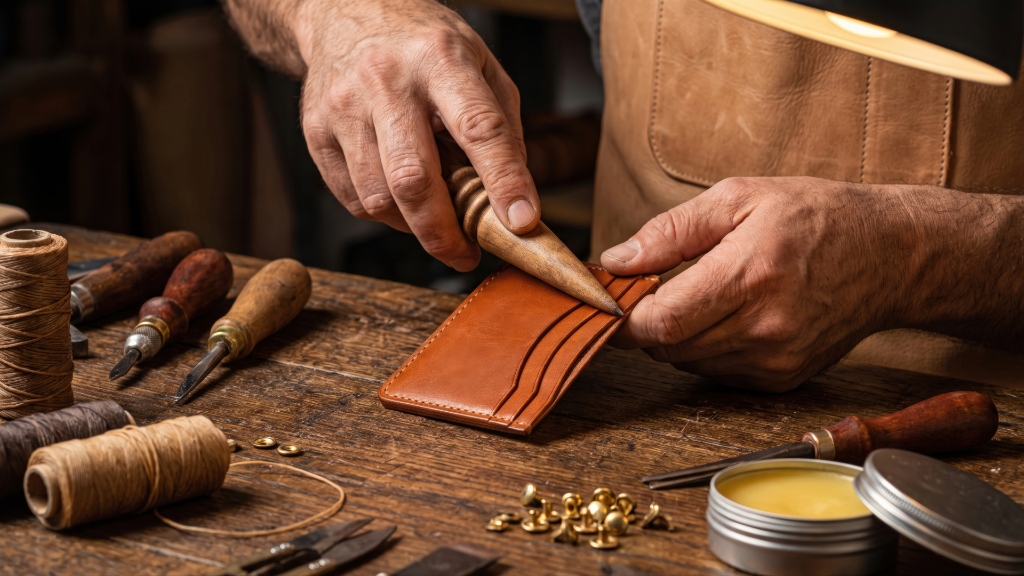
    Vegetable-tanned cowhide can be raw-edge burnished with beeswax and carnauba to a glass-like sheen without synthetic edge paint, ideal for heritage belts, satchels, and molded cardholders.

  • Drape, Elasticity & Weight Reduction (Drum-Dyed Nappa)

    Chrome and chrome-free drum-dyed calfskin or lambskin weighs 15–20% less per square foot and recovers instantly from creasing—essential for leather jackets, hobo bags, and quilted crossbodies.

  • Combination / Retanned (Chromexcel-Style) Hides

    Combines a chrome-tanned base for tensile softness with a secondary vegetable retannage and hot-stuffed paraffin waxes for pull-up character and rugged outdoor durability.

Ready to apply these specifications to your brand's next leather collection?
Chapter 04 // Engineering & SkivingUnicon Leather Engineering Standard

What Leather Thickness (Millimeter & Ounce Gauge) Should Brands Specify by Product Category?

Direct Answer (Executive Summary)

Leather thickness is measured worldwide in millimeters (mm) or ounces (where 1 oz equals 1/64 inch or 0.4mm), and selecting the correct gauge determines a product's weight, structural integrity, and stitch durability. Garment leather jackets require ultra-supple 0.6mm–0.9mm (1.5–2.25 oz) lambskin or 1.0mm–1.2mm cowhide; luxury handbags require 1.2mm–1.6mm (3–4 oz) calfskin; wallets require precision-skived 0.5mm–0.9mm interior pockets; and bridle belts require heavy 3.2mm–4.0mm (8–10 oz) full-grain bends. Unicon Leather utilizes precision German Fortuna band-knife splitting and edge skiving to hold tolerances within ±0.1mm.

Statistical Proof & Laboratory Benchmarks:

0.4 mm (1 oz)Minimum Edge-Skive Tolerance

Precision German band-knife skiving prevents bulky seams on turned wallet pockets.

0.6–0.9 mmOuterwear Lambskin Gauge

Optimal weight-to-tear ratio for tailored leather jackets and blazers.

3.2–4.0 mmSingle-Bend Bridle Belt Gauge

Zero-stretch full-grain shoulder/bend cut rated for >40 kg buckle pull load.

Key Procurement & Technical Specifications:

  • Custom Leather Jackets & Outerwear (0.6mm – 1.2mm / 1.5–3.0 oz)

    0.6–0.8mm drum-dyed sheep/lambskin nappa for luxury fashion jackets and trench coats; 1.0–1.2mm full-grain cowhide or buffalo for motorcycle and heritage aviation jackets.

  • Luxury Handbags, Totes & Briefcases (1.2mm – 1.8mm / 3.0–4.5 oz)

    1.2–1.4mm calf nappa or Saffiano with Salpa (bonded leather) or Texon reinforcement for structured handbags; 1.6–1.8mm vegetable-tanned cowhide for unlined totes and briefcases.

  • Travel Duffels & Weekender Bags (1.6mm – 2.2mm / 4.0–5.5 oz)

    Heavy-duty Crazy Horse pull-up or oil-tanned bovine leather paired with 2.5mm bridle leather handle tabs to withstand 25+ kg carry loads.

  • Small Leather Goods & RFID Wallets (0.5mm – 1.2mm / 1.25–3.0 oz)

    1.0–1.2mm exterior shell paired with 0.5mm–0.6mm band-knife skived card-slot interiors and 0.4mm feathered folded edges to keep bifold profiles under 11mm total thickness.

Ready to apply these specifications to your brand's next leather collection?

Direct Factory Sampling Desk · Bantala & Noida

Evaluate Our Full-Grain & Vegetable-Tanned Leathers Firsthand

Order a physical Unicon Leather Master Swatch Book featuring 25+ LWG Gold/Silver hides (Tuscan Veg-Tan, Calf Nappa, Lambskin Outerwear Nappa, Saffiano, and Crazy Horse Pull-Up) or submit your Tech Pack for a 7–14 day custom prototype.

Chapter 05 // Global Import ComplianceUnicon Leather Engineering Standard

What Chemical Safety & Import Compliance Certifications Are Required for USA & EU Markets?

Direct Answer (Executive Summary)

Importing leather goods into the European Union, United Kingdom, and United States requires documented laboratory compliance with EU REACH Annex XVII (Regulation EC 1907/2006), US CPSIA, and California Proposition 65. These laws strictly prohibit hexavalent chromium (Cr VI ≥ 3 ppm), carcinogenic Azo dyes (≥ 30 ppm), excessive lead in surface coatings or brass hardware (≥ 90 ppm), cadmium (≥ 75 ppm), and nickel release on skin-contact metal fittings. Unicon Leather provides batch-specific SGS, Intertek, or Eurofins chemical test reports alongside Certificates of Origin and HS Chapter 4202/4203 customs documentation.

Statistical Proof & Laboratory Benchmarks:

< 90 ppmTotal Lead Limit (Prop 65 / CPSIA)

Applies to all leather finishes, edge lacquers, zippers, and solid brass hardware.

< 30 ppmAzo-Free Dye Threshold

Tested per ISO 17234-1 across all 24 restricted aromatic amines under EU REACH.

< 0.5 µg/cm²/wkNickel Release Limit (EN 1811)

Mandatory for belt buckles, jacket snaps, and handbag clasps in EU/UK retail.

Key Procurement & Technical Specifications:

  • European Union & UK: REACH Annex XVII Verification

    Covers Entry 47 (Chromium VI < 3 mg/kg), Entry 43 (Azo colorants < 30 mg/kg), Entry 27 (Nickel release), Entry 51/52 (Phthalates < 0.1%), and POPs (Short-Chain Chlorinated Paraffins free).

  • United States & Canada: California Prop 65, CPSIA & CBSA

    Full third-party lab verification for lead-free and phthalate-free leather coatings and hardware, preventing Prop 65 warning label mandates for California retail and Amazon FBA distribution.

  • Australia & Japan Duty-Free Preferential Trade

    As a registered Indian export house, our shipments qualify for 0% preferential import tariff into Australia (Ind-Aus ECTA) and UAE (CEPA), accompanied by official Certificates of Origin.

Ready to apply these specifications to your brand's next leather collection?

Chapter 06 // Atelier Construction BenchmarksUnicon Leather Engineering Standard

How Should Brands Audit Leather Craftsmanship, Stitching, Edge Paint & Hardware?

Direct Answer (Executive Summary)

True luxury leather craftsmanship is measured by four engineering parameters: stitch density (stitches per inch or SPI), edge-paint thermal resilience, reinforcement architecture, and hardware corrosion resistance. High-end leather goods utilize bonded nylon or braided polyester thread (Coats Nylbond / Gütermann) stitched at 6–8 SPI for bags and 9–11 SPI for wallets, paired with 3–4 hand-sanded coats of Italian edge paint and solid brass or PVD-plated zinc alloy hardware. Unicon Leather subjects all custom hardware to a 72-hour ASTM B117 neutral salt-spray test and a 25 kg dynamic strap-pull test prior to bulk assembly.

Statistical Proof & Laboratory Benchmarks:

72+ HoursSalt-Spray Corrosion Resistance

ASTM B117 testing on PVD vacuum-plated solid brass and stainless steel fittings.

6–10 SPIPrecision Stitch Density

6–8 SPI on structured bags; 9–10 SPI on fine wallets using Coats bonded thread.

4 CoatsHand-Sanded Italian Edge Paint

Heat-creased and flex-tested to 10,000 cycles at -10°C to +45°C without cracking.

Key Procurement & Technical Specifications:

  • YKK Excella® & Solid Brass Custom Hardware

    Dual-polished YKK Excella or Riri metal zippers alongside custom 3D CNC-moulded solid brass buckles, dog hooks, and magnetic locks in 24k Gold, Palladium, Brushed Antique, or Gunmetal PVD finishes.

  • 4-Stage Italian Edge Lacquer & Heat Creasing

    Raw cut edges are beveled, primed with base filler, heat-ironed, hand-sanded with 600-grit abrasive, and sealed with three topcoats of flexible Fenice Italian edge paint.

  • Internal Reinforcement & Shape Retention Matrix

    Strategic lamination of Italian Salpa (regenerated leather fiber), non-woven Bontex, high-density EVA foam, and tear-resistant Velodon tape along zipper lines and handle anchors.

Ready to apply these specifications to your brand's next leather collection?

Chapter 07 // Commercial Sourcing EconomicsUnicon Leather Engineering Standard

What Are Standard B2B Minimum Order Quantities (MOQs), Lead Times & Cost Drivers?

Direct Answer (Executive Summary)

In B2B contract leather manufacturing, Minimum Order Quantities (MOQs) are governed by tannery drum-dyeing batch minimums (typically 300–500 sq. ft. per colorway) and hardware die-casting setups. Unicon Leather offers industry-leading boutique flexibility starting at 50–100 pieces per style for custom leather jackets, 100 pieces per style for leather handbags and travel bags, and 150–200 pieces for small leather goods and belts. Physical counter-samples are delivered globally via DHL Express in 7–14 business days, while bulk production is completed in 25–45 business days upon Golden Sample sign-off.

Statistical Proof & Laboratory Benchmarks:

50–100 PcsStarting MOQ Per Style

Supports 2 colorways per style (50 pcs/color) using LWG partner tannery hides.

7–14 DaysExpress Prototype Turnaround

CAD pattern drafting, leather cutting, and DHL air dispatch to buyer studio.

55–65%Raw Leather Share of BOM Cost

Hide grade and cutting yield efficiency (15–18% natural waste factor) drive FOB price.

Key Procurement & Technical Specifications:

  • Transparent Bill of Materials (BOM) Costing

    Every FOB/DDP quotation breaks down net leather consumption (sq. ft. per unit + cutting wastage allowance), lining fabric, reinforcement, hardware unit costs, labor minutes, and packaging.

  • Custom Hardware Mould Amortization

    Bespoke 3D brass or zinc-alloy logo moulds cost $150–$350 one-time setup (completed in 7 days) and are refundable/amortized on orders exceeding 500 units, with 100% exclusive mould custody.

  • Turnkey FOB, CIF & DDP Global Logistics

    Choose Priority Air Freight (3–5 days door-to-door via DHL/FedEx) for urgent seasonal drops or Ocean LCL/FCL container shipping (22–35 days) with full DDP customs clearance.

Ready to apply these specifications to your brand's next leather collection?

Chapter 08 // Quality Assurance & InspectionUnicon Leather Engineering Standard

How Does AQL 2.5 Quality Control Prevent Defective Bulk Leather Shipments?

Direct Answer (Executive Summary)

Acceptable Quality Limit (AQL) 2.5—defined under international standard ISO 2859-1 (ANSI/ASQ Z1.4)—is the statistical inspection protocol used by luxury fashion houses to guarantee batch consistency before shipment release. Under General Inspection Level II (AQL 0.0 Critical, 2.5 Major, 4.0 Minor), random cartons are audited across hide grain matching, stitch tension, edge-paint adhesion, hardware plating, barcode accuracy, and moisture content (<14%). If defective units exceed the statistical threshold, 100% of the batch undergoes re-inspection and rectification at the factory's expense prior to dispatch.

Statistical Proof & Laboratory Benchmarks:

0.0% CriticalZero Tolerance for Safety Defects

100% metal-detector scanning for broken needle fragments and sharp hardware burrs.

AQL 2.5 / 4.0Major / Minor Defect Standard

ISO 2859-1 Level II audit accompanied by a 40+ photo pre-shipment QC dossier.

< 14% RHIn-Carton Moisture Control

Digital hygrometer verification + DMF-free silica gel packets prevent transit mold.

Key Procurement & Technical Specifications:

  • Stage 1: Raw Hide Inspection on Light Tables

    Every hide is graded under 1,000-lux daylight lamps to mark natural tick bites, veins, or growth lines so clicker dies cut primary exterior panels strictly from Grade-A prime bend zones.

  • Stage 2: In-Line Assembly & Needle-Detection Audit

    Roving QC engineers inspect skiving thickness, glue margin cleanliness, and stitch back-tacking at every workstation, followed by conveyor metal detection.

  • Stage 3: Pre-Shipment AQL 2.5 Report & Third-Party Access

    Buyers receive a comprehensive PDF inspection report with high-resolution macro photography and carton drop-test results—or may appoint SGS, QIMA, or Bureau Veritas for on-site inspection.

Ready to apply these specifications to your brand's next leather collection?
Custom OEM/ODM Order Desk

How Can Brands Request a Custom Leather Order or Swatch Kit?

Submit your tech pack, target leather grade, or estimated order volume below, or return directly to https://www.uniconleather.com/. Our senior export engineering team returns a comprehensive Bill of Materials (BOM), leather yield breakdown, and FOB/DDP quote within 12–24 business hours.

Included With Every Custom Order Inquiry:

  • Signed bilateral Non-Disclosure Agreement (NDA)
  • LWG tannery certificate & EU REACH / Prop 65 test documentation
  • Tiered pricing for 50–100, 300, and 1,000+ piece production runs
Tap quick-tags below or type specifications
Attach Tech Pack, Sketches or CAD Reference File (Optional · Max 4.5 MB)Files up to 4.5 MB (.PDF, .PNG, .JPG, .ZIP, .AI) are attached directly to your RFQ dispatch under mutual NDA protection. For larger files, paste a Drive/WeTransfer link above.
Atelier Finishing & Tooling Standards

In-House Manufacturing Capabilities

Proprietary artisanal and industrial finishing techniques executed in-house for international private labels and luxury houses.

Embossing & Debossing

Embossing & Debossing

Blind deboss, gold foil, silver foil, heated branding iron.

Hand Saddle-Stitching

Hand Saddle-Stitching

Generational waxed linen thread, double-needle artisan seam.

Italian Edge Inking

Italian Edge Inking

3–5 coats hand-painted, heat-sealed Italian Fenice lacquer.

Micro-Skiving & Splitting

Micro-Skiving & Splitting

German Fortuna bevel skiving down to 0.4mm tolerances.

Custom Metal Tooling

Custom Metal Tooling

Solid brass cast moulds, PVD vacuum plating, laser-etched hardware.

Pantone Leather Dyeing

Pantone Leather Dyeing

Custom drum dyeing, aniline dip, pull-up wax finish to exact codes.

Embossing & Debossing

Embossing & Debossing

Blind deboss, gold foil, silver foil, heated branding iron.

Hand Saddle-Stitching

Hand Saddle-Stitching

Generational waxed linen thread, double-needle artisan seam.

Italian Edge Inking

Italian Edge Inking

3–5 coats hand-painted, heat-sealed Italian Fenice lacquer.

Micro-Skiving & Splitting

Micro-Skiving & Splitting

German Fortuna bevel skiving down to 0.4mm tolerances.

Custom Metal Tooling

Custom Metal Tooling

Solid brass cast moulds, PVD vacuum plating, laser-etched hardware.

Pantone Leather Dyeing

Pantone Leather Dyeing

Custom drum dyeing, aniline dip, pull-up wax finish to exact codes.

Laser Cutting & Filigree

Laser Cutting & Filigree

CNC optical cutting, micro-perforation, intricate leather cutouts.

Artisan Hand-Burnishing

Artisan Hand-Burnishing

Natural beeswax and carnauba edge burnishing with bone slickers.

RFID Signal Shielding

RFID Signal Shielding

Aerospace-grade copper/nickel shielding foil embedded in lining.

Quilting & Padding

Quilting & Padding

Diamond, chevron, and custom matelassé padding with EVA foam.

Exotic Texture Pressing

Exotic Texture Pressing

Crocodile, python, lizard, and ostrich heat-embossed bovine leather.

Custom Silk & Twill Linings

Custom Silk & Twill Linings

Yarn-dyed jacquard, organic cotton twill, and sueded microfibers.

Laser Cutting & Filigree

Laser Cutting & Filigree

CNC optical cutting, micro-perforation, intricate leather cutouts.

Artisan Hand-Burnishing

Artisan Hand-Burnishing

Natural beeswax and carnauba edge burnishing with bone slickers.

RFID Signal Shielding

RFID Signal Shielding

Aerospace-grade copper/nickel shielding foil embedded in lining.

Quilting & Padding

Quilting & Padding

Diamond, chevron, and custom matelassé padding with EVA foam.

Exotic Texture Pressing

Exotic Texture Pressing

Crocodile, python, lizard, and ostrich heat-embossed bovine leather.

Custom Silk & Twill Linings

Custom Silk & Twill Linings

Yarn-dyed jacquard, organic cotton twill, and sueded microfibers.